Pedestrian driveway safety
Did you know that a person driving into or out of a driveway must give way to a road user on a footpath, cycle path, or shared path?
That means you must give way to:
- Children on scooters
- Children on bicycles with wheels less than 355 mm diameter
- Mobility scooter riders
- E-scooter riders (those travelling over 15 km/h should be on the road, like adult cyclists)
- Pedestrians of all ages and abilities
That’s a requirement of the current legislation (Land Transport (Road User) Rule 2004, cl. 4.4.1).
Most of the people above are likely to be travelling at speeds of 10–15 km/h, including the kids. That’s faster than you might expect, and why it’s so critical that we go slowly and attentively when we’re behind the wheel.
What makes a driveway less safe?
The NZ Transport Agency’s advice is to drive slowly enough in or out of driveways so that you can stop, even if a footpath user appears suddenly.
Marjon’s driveway had no visibility of the footpath. She was concerned about safety, so she drove slowly and carefully but one day the worst happened: she hit a child cyclist. It was a devastating event for all involved, and the case was adjudicated in court. So, what went wrong? Marjon couldn’t see along the footpath before the bonnet of her car was across it.
From a planning and design perspective, we want driveways that allow people to see each other, so there are no surprises. High fences, hedges, or other landscaping that blocks the view of the footpath or road can cause problems.
Simple changes for existing driveways
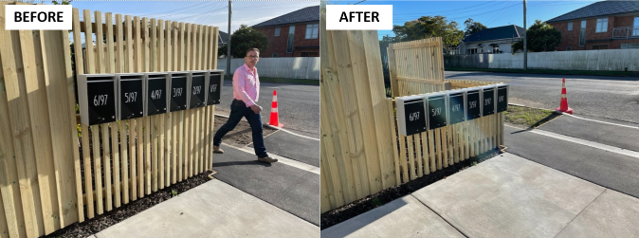
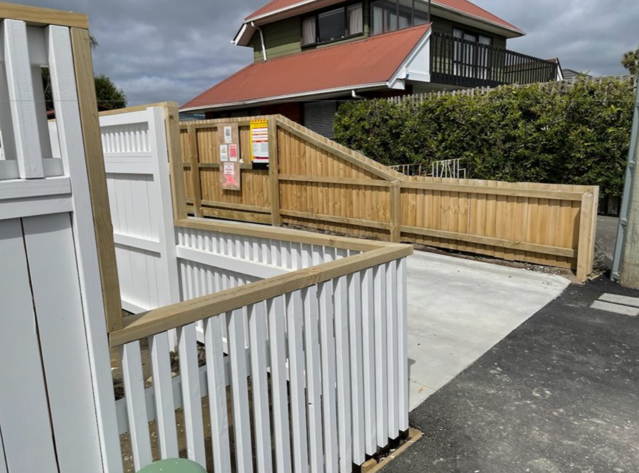
If you have a fence (or hedge) that extends up to your driveway or your neighbour’s driveway, and which grows next to the footpath, consider angling or cutting it down. A maximum of 0.5 m height is ideal. For a fence, you can alternate vertical slats or leave a gap to allow visibility. This will allow drivers (including you!) to see path users.
You don’t need to reduce the entire fence to that height, just the section that’s up against the driveway or path. Your District Plan may have further fencing requirements that must be met, so for details about visibility splays and how these should be calculated, reach out to your local Council.
If you’re a landlord, check your tenant’s driveways too and help them out with better visibility if it’s needed. If you’re a tenant, reach out to your landlord and ask if these small improvements can be made, and consider sharing this post with them.
Design tips for new driveways
The best driveways are:
- Short (under 12 m)
- Away from the site boundary
- Wide enough for the expected users
- Level (where possible)
- Have good visibility!
Short driveways and parking at the front of the site are best. The risk of runover injuries doubles for longer driveways (12 m or more). Additionally, longer driveways and driveways that access a major road might need to provide extra room to turn on-site (so you can enter and exit forwards).
Locate driveways away from site boundaries. A future neighbour could add a new fence or landscaping that affects visibility, or they might not maintain plants that are kept tidy now. it’s best to avoid fencing immediately against the driveway if you can, but if it proves necessary, visually permeable or lower height options are better than solid fences or high walls. International standards recommend a 1.0 m maximum height for fences because it is 1.1 m to the top of a child’s head (for the typical age and height of children travelling independently).
If multiple users share the driveway, or it will be regularly used by larger vehicles such as rubbish trucks, emergency services, or furniture removal trucks, ensure the driveway is wide enough for safe use. Your District Plan is likely to also have specific requirements for this.
Lastly, steep driveways are sometimes unavoidable. When that’s the case, or when there’s a blind corner, extra design and engineering work is needed to make them safer.
We can help!
If you have a large or small construction project that requires vehicle access, get in touch with transportation experts sooner rather than later. We can save you time and expense by spotting access and manoeuvring issues early in the design process, or by working with the team from the beginning we might just avoid them entirely.