NZTA Mode-shift vs Safety Model update
Objective
Client
Location
Deliverable
Timeframe
Project Status
Background
Previous research for NZ Transport Agency on “Mode-shift impacts on safety” sought to determine the actual and potential safety impacts of achieving mode shift from private motorised vehicles to public transport, active modes and micro-mobility, in conjunction with making changes to the overall volume of travel by all modes. It aimed to identify the individual and collective safety profiles of different travel modes, and the potential safety outcomes for different demographic groups that could arise from mode shift away from private motorised vehicles in New Zealand (NZ).
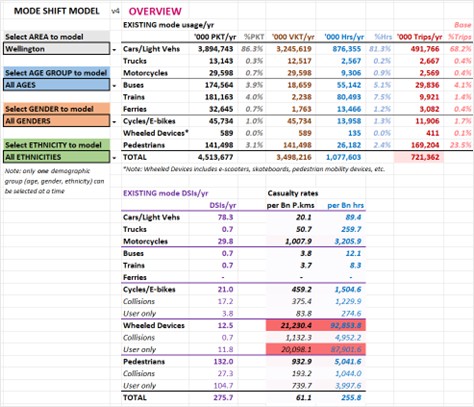
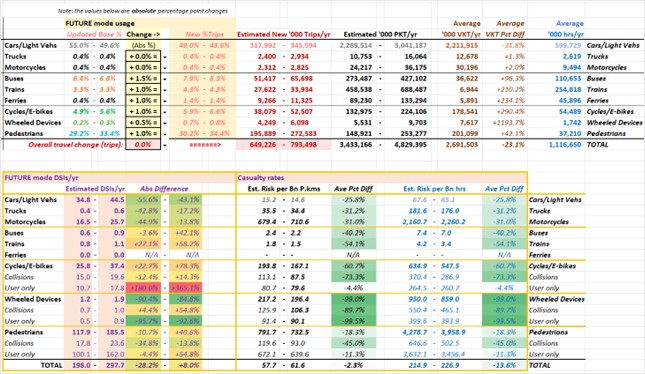
Following extensive literature review and data analysis, an Excel spreadsheet-based model was developed to enable mode-shift scenario testing for various situations. The model allowed users to select a combination of city/region and demographics across NZ, and adjust the future mode usage for this combination. Users could also adjust the overall amount of travel (VKT) to reflect any longer-term changes in transport policies. From this, the potential road-safety outcomes can be calculated, both in total numbers of deaths and serious injuries (DSIs), and by exposure (DSIs per km or hour travelled).
Not all potential factors identified were built into this initial model, so the original research made several recommendations for future enhancement of the model, and for strengthening the data underpinning it. These included:
- Investigating likely changes in average trip lengths when people change modes
- Investigating typical vehicle-occupancy factors for private/public motor vehicles, to allow for increased person-kilometres travelled (PKT) without increasing VKT to the same extent.
- Identifying and separating out casualty figures for active mode crashes/falls involving and not involving motor vehicles (e.g. slip/trip, hit object, etc).
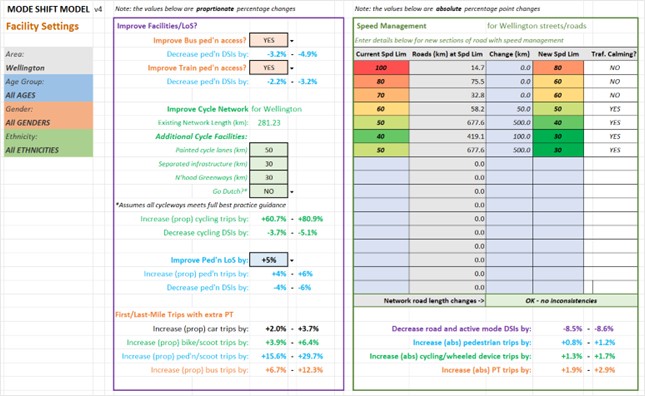
- Investigating the safety and mode shift effects of introducing lower speed limits to parts of urban areas.
- Updating the model to present a range of possible high and low values (i.e., error margins), to highlight the likely range and uncertainty in some of the estimates.
Recent funding by Transportation Group NZ and their NZMUGS sub-group allowed ViaStrada to explore these factors further and develop an updated model. The original model (v3) has now been further updated to include these additional features.
You can access the updated (v4) model tool as an Excel spreadsheet template, and detailed user guidance (including explanation of the background calculations) can be accessed here.